
Historial
-
1940s
THE ENGINE FACTORY OF LINNAVUORI IS BORN
Finland’s second aircraft engine factory was built in Linnavuori, a village in Siuro Nokia in 1942. The main mission of the factory was to function as a core place for repairing aircraft engines.
Since Europe was threatened by outbreak of war, the engine department of the State Airplane Factory, located in Tampere, had been relocated to Kokkola in Western Finland. The difficulty by the distance created the need for founding a new factory for airplane engines. Prehistoric Linnavuori (castle mountain) near the village of Siuro in Nokia was selected. The mountain offered good opportunities for underground caves, a railroad was nearby and electricity could be easily arranged. The building started in November 1942.

The production was started in partly unfinished premises in March 1944. The first product was the assembly of 30 fuselages for the VL Myrsky II (Storm) fighter. This was shortly followed by rework of airplane propellers and at the end of summer the bearing foundry started operation. The initially intended operation, rework of airplane engines, could be started only after the war in 1947.
After the end of World War II the factory was fully transferred for production of war reparations. Since the engines were nearest, production of nearly all diesel engines as well as air compressors were selected for Linnavuori. The extremely tight delivery schedules offered no time for own development, but licensing was seen as the only alternative, luckily these could be sourced for Sweden. Totally 60 units of June-Munktell crude oil engines were manufactured for schooners built for war reparations. With license from Skandiaverken diesel engines were manufactured for locomotives and air compressors with license from Atlas Diesel. Only these compressors remained in production until 1960’s.

Production of diesel engines based on own development and design was started in 1946, when small series of 440 and 648 type engines were made mainly for propulsion and power generation applications. Part of them were delivered already for war reparations and later they were continued to be sold to the Soviet Union by Valmet Shipyards. In 1947 also the development of 4 cylinder otto-engines was begun with intention for powering the first Valmet tractor, fueled either by gasoline or petroleum.

In the late 1940’s State Railroads had a need for light rail cars that should be powered by a diesel engine. Rail cars would be manufactured by the Valmet Airplane factory in Tampere and the natural selection for an engine supplier was Linnavuori Works. So the decision for development of a larger diesel engine was made. It was to be an inline 8 with 12-liter displacement developing 180 bhp. In further development it was made also mainly for power generation applications featuring charge air cooler and twin turbocharger technology and developing 250 bhp.


-
1950s
POWER GENERATION OF AGRICULTURE MACHINES BEGINS
The golden 1950’s brought along the serial production of petrol engines for the Valmet 15 -tractor. Development of a three cylinder diesel tractor engine begun. It was considered an innovative success.
The serial production of the petrol engine for Valmet 15 model tractor, ”Tensioner of Barbed Wire”, rated at 15bhp was started in 1951, later the power was increased to 20hp. This was the beginning of power source production in Linnavuori for farming equipment that would continue powerfully developing until the next millennium and beyond.

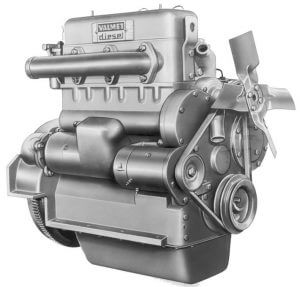
In the early 1950’s also development of small three cylinder diesel engines was started with focus on farm tractors and the production started in 1957. Construction proved to be a direct hit. The engineers in Linnavuori succeeded to foresee future demands so well that it was not necessary to change the basic concept throughout the coming decades. The engine featured ao. wet cylinder liners, direct injection and cross flow cylinder head. Some 50 years later another engine manufacturer launched an engine with similar features as “world premier”.
-
1960s
MORE POWER, PLEASE!
Tractors become larger and a bigger four cylinder engine is taken into production. Production of engines for ships and boats also keeps the factory workers busy.
The power demand of tractors continued to increase and so a four-cylinder diesel was developed. This was introduced to production in 1963 for the new, big Valmet tractor. Further in 1969 a new Valmet was launched as first farming tractor in the world powered by turbocharged diesel engine manufactured by Valmet. This engine was then developed also for other applications such as Valmet forest machines and Sisu trucks.
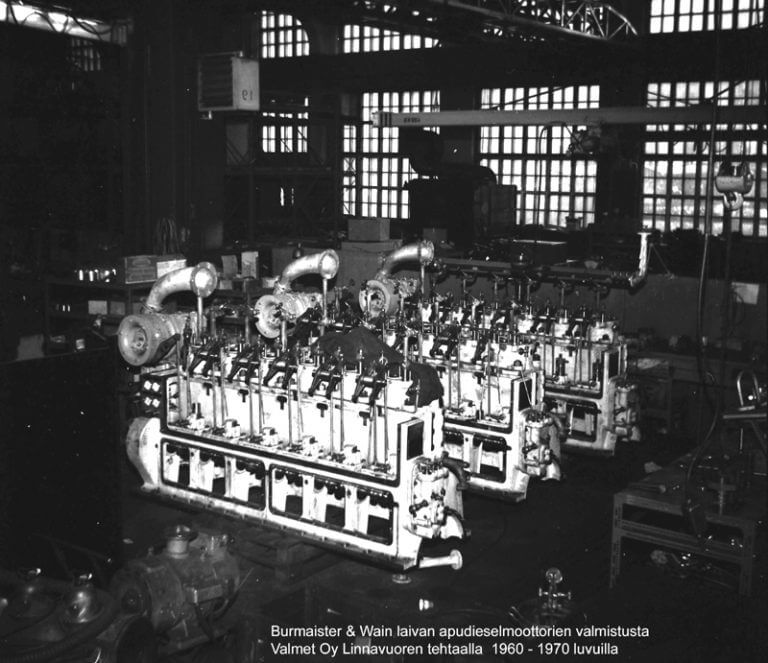
With license from Burmeister & Wain also larger auxiliary engines were manufactured for Valmet Shipyard until early 1980’s.
In 1950’s and 60’s also some 15.000 single cylinder Vire engines were manufactured. These were mainly used in small fishing boats, but also quite widely as auxiliary engines in sailboats.

-
1970s
GETTING NOTICED
An engine series that is meant for more extensive use is developed in Finland. An engine equipped with a Comprex-brace gets special attention. A crew transport vehicle called Pasi (equipped with a Valmet turbo intercooler engine) gets noticed internationally – it became a favorite of the UN troops in the Nordics.
1974 saw already the birth of the 50.000th engine. Beginning of the decade had been effectively used for developing an all new engine range for which also other major applications had been considered, not only in Valmet tractors or other “family” products.
In the mid 1970’s an all new engine assembly facility was inaugurated, whereas the first member of the new engine family, the six cylinder 6,6-liter turbo engine saw daylight. By the end of the decade also three and four cylinder models were introduced. Among these was also the four pot engine with special pressure-wave charging technology from BBC in Switzerland. This engine was even called “the mother of high torque engines” with torque as high as 424 Nm and 27% torque rise, figures never seen before in tractors. Thus this engine, first in the world with Swiss Comprex charger in serial production, also set off vivid discussion around the topic in the engine world.

-
1980s
COMPETITIVE EDGE FROM TECHNOLOGY
New fuel and supercharging techniques and innovative engine development brought along achievements, which are trademarks of AGCO produced engines even today.
When Valmet acquired tractor operations from Volvo in 1979, the component exchange with Volvo BM was an important issue on the negotiation table. Valmet 3 and 4 cylinder engines were selected to power the new tractor model range. For this purpose, the only a few years old engine range was further developed to the second generation modular engine family. The most significant difference to old was that the engine would become part of the load bearing chassis of the tractor. This feature has remained and further developed, in fact has also become the feature of all AGCO tractor families. And has been adopted also by some competitors in their products. With new fueling and turbocharging technologies excellent torque characteristics were achieved, which has become the trademark of Valmet / SisuDiesel / AGCO Power engines over the course of years.
Big combines and trucks required constantly more power. For this reason, the company started to develop a robust 7,4 liter 6-cylinder engine in the early 1980’s. This was introduced in production in 1985. During the development of this engine a major innovation was made: the wet cylinder liner was supported also at mid-stroke. This was a unique technological solution in this size engine. The configuration has many features not seen in many competing engines even yet today. The stiffening effect eliminates the cavitation corrosion created by the vibration typical of wet cylinder liners. The support also ensures the liner to remain round, resulting in reduced oil consumption and consequently reduction in particulate emissions. Respectively the coolant circulates most effectively around the top part of the cylinder, exactly where the heat load is at peak.
-
1990s
TIME OF BIG DECISIONS AND CHANGES
In the 1990’s many important decisions with long-term effects were made in Linnavuori. In addition, the factory transitioned to producing big six cylinder engines. The specialization in off-road engines began.
Several significant and far-reaching decisions and changes were made in Linnavuori during 1990’s. In 1986 Valmet had made an agreement of cooperation with Austrian Steyr-Daimler-Puch AG. One of the objectives was to jointly develop a new diesel engine generation and to share the manufacturing between factories in Nokia and in Steyr. Due to finance and technology conflicts the cooperation came to an end and finally Steyr discontinued its own engine manufacture, whereas Valmet decided to finalize development and start serial production.
New engine range was introduced in record time and conveniently for new generation Valmet tractor models by the end of 1991. Already from the very beginning of development the upcoming emission requirements and noise emission reduction were taken into consideration. It was also apparent that engines were dimensioned for turbocharging and charge air cooling.
Steyr Landmaschinentechnik became a Valmet engine customer in 1993 when it was developing its own large size tractor range. With this Steyr came back to square 1 as drafted in 1986, the user of Valmet engines. By the end 1990’s the fluent collaboration brought to market place the first electronically controlled SisuDiesel engine, which was driving the tractor with a stepless CVT transmission developed by Steyr.

-
2000s
DIGITALIZATION INTENSIFIES PRODUCTION
In the year 2000 over 20 000 engines were produced in Linnavuori for the first time. After the turn of the millenium an electronic control system was introduced in more and more engine types and customer solutions.

Beginning of the new millennium increased further the speed in engine research and development. The electronic control system was implemented in several engine types and customer applications. Cooperation with customers became ever more intense in pressure of stricter emission requirements.
Year 2000 was yet another milestone for the factory; more than 20.000 manufactured engines in Linnavuori.
In 2002 the next change in ownership: Kone Corporation acquired the complete capital stock of Partek. This didn’t last too long, already in August 2003 the personnel were informed that Kone had made a preliminary agreement with AGCO Corp. based in Georgia, USA, for selling the engine factory. Early 2004 competition authorities both in the USA and in Europe had approved the acquisition.
Technological development continued with rapid steps, fuel injection based on common rail technology was introduced, which is controlled with the SisuTronic control system, now already in third generation. By the AGCO ownership the deliveries began also to corporate facilities in Kansas and Minnesota in the USA. Due to the ever increasing performance demand, in 2007 a quite unique engine configuration in this power category was launched: inline engine with 7 cylinders.


-
2010s
NEW NAME & INTERNATIONAL GROWTH
2012 business operations integrated even closer into AGCO corporation’s core business by shortening the company name to AGCO Power Inc.
The third AGCO Power engine plant was opened in 2012 next to the AGCO tractor plant in Changzhou, China, in leased premises. At the same time AGCO Corp realized one of its biggest investments ever by building its own plant a short distance away in the same town. Engine production moved into this facility in early 2015 for manufacture of approximately 10.000 three- and four-cylinder diesel engines developed for a new global tractor family of AGCO.
An engine assembly plant was launched in 2015 in Argentina. Production capacity is aimed for production of engines for tractors and combines for the local market, approx. 2.000 units annually.
-
2020s
UN ESPECTRO MÁS AMPLIO DE ENERGÍA
Hoy en día, las continuas inversiones en fabricación de componentes, montaje, logística y pruebas hacen de la planta de AGCO Power en Linnavuori la fábrica de motores más avanzada del mundo.
En 2022 se lanzó la plataforma de los motores CORE. La moderna plataforma completamente nueva del motor de combustión se diseñó para el trabajo de hoy en día contemplando los requisitos del mañana. Actualmente, la familia de motores CORE consta de tres motores, el CORE50 de 5 litros y 4 cilindros, el CORE75 de 7,5 litros y 6 cilindros y el CORE80 de 8 litros y 6 cilindros. El diseño innovador y el rendimiento de los motores CORE no pasaron desapercibidos – El motor CORE75 fue elegido como el Motor del Año 2023 por Diesel Progress, y el motor CORE80 fue elegido como el Diésel del Año 2026 por Powertrain.
AGCO ha invertido más de 100 millones de euros en Finlandia en la última década, mayormente en Linnavuori. En 2024 se inauguró el primer Laboratorio de Energía Limpia de AGCO en Linnavuori junto con un nuevo Centro para Visitantes y de Formación. En 2025 comenzó a funcionar una nueva sala de mecanizado de motores CVT, así como una ampliación de las operaciones de remanufactura de AGCO Power.